Jan 20, 2023 | Real Estate
 There is a good chance you have heard someone described as being house poor. What exactly does it mean? It is important to understand what it means to be house poor and how you can stay away from it.
House Poor Means Spending A Significant Chunk Of Your Income On Housing
Being house-poor means different things for different people. In general, it means spending a significant amount of your monthly income on recurring expenses related to your house. A few examples include your mortgage, the interest on your mortgage, your property taxes, and HOA expenses. Owning a house can be expensive, and it is important for you to budget carefully. In general, you could not spend more than one-third of your monthly pay on your rent or your mortgage. If you are spending significantly more than this recommendation, you might qualify as house-poor.
How To Avoid Becoming House-Poor
Fortunately, there are several strategies you can follow if you want to avoid becoming house-poor. First, make sure you budget ahead of time. Understand exactly how much money you can spend on your home, and make every effort to stick to that number. Furthermore, before you purchase a house, make sure you get a home inspection completed. There are a lot of people who have their savings wiped out by unforeseen expenses. If you get an inspection before you buy a house, you can plan for those ahead of time. Finally, make sure you reduce your debt-to-income ratio before you buy a house. That way, you can qualify for the best home loan possible.
Do Not Spend More On Housing Than You Can Afford
In the end, it is critical for you to avoid spending more money on your house than you can afford. Remember that you should not spend more than one-third of your monthly pay on housing. If you do, your budget may be stretched thin and other areas, and you might have a difficult time covering other expenses. Do not hesitate to reach out to an expert who can help you find the right house for yourself and your family.
Jan 13, 2023 | Real Estate Tips
Many people view their furry friends as members of the family. If you have pets at home, you need to make sure they are well taken care of. That means taking a closer look at an important pet safety checklist. What are a few of the most important items you need to include on this checklist if you want to make sure your dogs and cats are safe?
Regular Checkups Are Critical
First, you need to make sure that you take your pets to the veterinarian at least once per year. Just as you go to the doctor once per year, your pets need to go to the doctor once per year as well. Regular check-ups are important because the veterinarian could identify issues that you might not otherwise have noticed. In addition, this gives a veterinarian an opportunity to make sure your pets’ vaccinations are up-to-date.
Spay Or Neuter Your Pets
Unless you plan on having kittens or puppies, you also need to make sure that your dogs and cats are spayed and neutered. There are already far too many animals in animal shelters, so if you are not planning on breeding dogs and cats, you do not want to add to the population unnecessarily. There might be opportunities for you to get this operation financed, which could make it more affordable.
Lock Up Unsafe Items
Keep an eye on your home environment as well. Keep a close eye on how much human food you give your dog or cat. There are certain items that are simply not healthy for dogs and cats, and some items could be poisonous. You should also make sure that any cleaning supplies are locked behind a cabinet door. That way, your pets do not ingest anything that could poison them.
Protect Your Furry Friends
These are a few critical steps that you need to take to make sure your dogs and cats are safe. If you are interested in learning more about the steps you can take to protect your furry friends, consider reaching out to a veterinarian who can help you.
Jan 12, 2023 | Real Estate
 After you have found the right house to meet your needs, you need to make the down payment to complete the transaction. Can you show up at the closing table with a suitcase full of cash? Of course, that would be a bit suspect, so that is not actually how it happens. What do you need to do to actually hand over the funds to buy the house?
The Down Payment Is Verified Beforehand
First, understand that the down payment is usually verified before you agree to the deal. Your real estate agent will work with you and the seller’s agent to ensure that you actually have the funds needed to buy the house. For example, you might need to send screenshots of your bank balance or investment portfolio as proof that you have the money. Your agent will work with you to ensure your confidential information remains so.
The Funds Are Typically Given Using A Wire Transfer
When it is time for you to complete the actual transaction, the real estate attorney will handle just about everything. The attorney will be responsible for collecting the money from the sale and ensuring that everyone gets the money they are owed. The attorney will provide you with the account information for where you need to wire the money. Prior to the closing date, you need to go to the bank and work with one of their experts to ensure the money is in your account and wired to the correct account destination.
The Real Estate Agent Will Confirm The Process Is Done
It is best not to wait until the last minute to wire the money into the account. Try to do this process ahead of time, and make sure either the attorney or your real estate agent says that the process has been completed. You do not want to run the risk of missing your closing date. If you have questions about the process, make sure you give the attorney’s office plenty of time to respond to you.
Determine Your Budget With The Help Of Your Real Estate Agent
This process is important for making sure you can afford the house you want. Work with your real estate agent to ensure you have the necessary funds for the down payment.
Jan 10, 2023 | Financial Reports, Housing Analysis, Real Estate
January 10, 2023 – Since the beginning of the pandemic, the housing market has experienced a series of highs and lows. The housing market was already strong prior to 2020, but the pandemic redefined the role of a home, creating a surge in demand which, coupled with record-low mortgage rates and limited housing supply, powered the housing market to multiple records during this unprecedented time – the fastest annual house price appreciation, the lowest days on market in the history of record-keeping, and a near-record annualized pace of sales. But, as mortgage rates increased alongside the Federal Reserve’s monetary policy tightening, the housing market froze up in the second half of 2022, with both buyers and sellers withdrawing from the market. Will the freeze continue well into 2023 or will the housing market begin to thaw?
“The main trend to watch is whether mortgage rates will go any higher and, if so, by how much.”
Three Scenarios for the 2023 Housing Market
The popular 30-year, fixed mortgage rate is loosely benchmarked to the 10-year Treasury note, and when investors are concerned about inflation, their appetite for buying bonds diminishes, which puts upward pressure on bond yields and, therefore, mortgage rates. The risk is that rates will continue to increase until we get sustained evidence that inflation is receding. So, the outlook for the housing market is largely dependent on the path of inflation. Below are three possible paths for inflation that are anchored to the Fed’s monetary tightening: the baseline case (the likely), the downside case (the bad), and the upside case (the good).
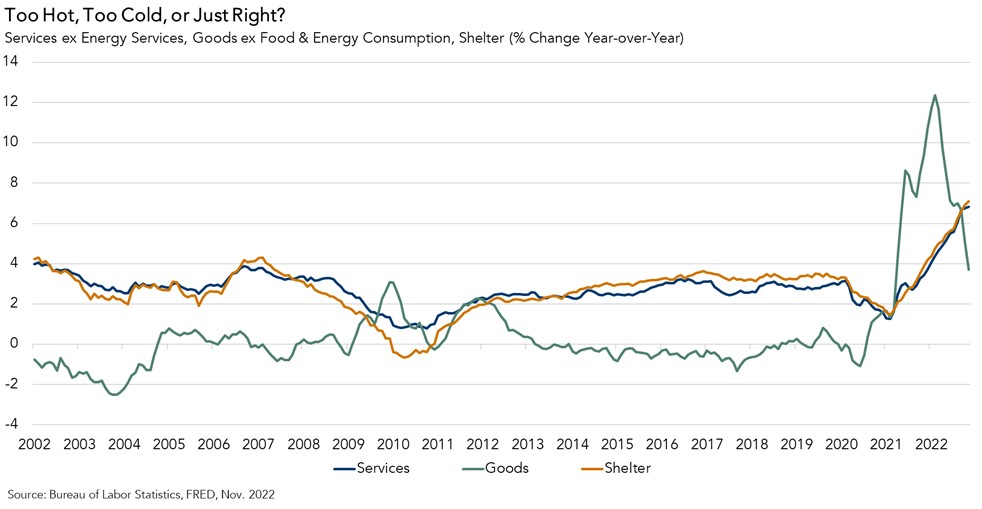
- The Likely: The Fed is focused on the dynamics of inflation in parts, and not all parts are trending in the same direction. Core goods inflation increased dramatically in 2021 due to COVID-related supply disruptions and a demand surge for goods by domestic consumers. However, that inflation surge is now quickly fading.Service sector inflation is still rising, largely due to the shelter component. Shelter is considered a service and makes up 57 percent of core services in the Consumer Price Index. By virtue of how it is measured, shelter inflation also lags observed rental and house price increases by approximately one year. Rent and price growth are now decelerating, meaning the shelter component of inflation will cool – it’s just a matter of time.Core services excluding shelter is the last component. Service providers are still struggling to find labor, their primary input. As a result, service sector wages are still growing quickly – faster than the overall rate of wage growth, which is relatively strong itself. The Fed aims to lower consumption demand by setting the federal funds rate at just the right level. The “terminal rate”— the level at which the Fed is expected to stop raising interest rates — for the baseline case is approximately 5 to 5.25 percent, based on FOMC projections. If the Fed reaches this level by mid-2023, then they will likely hold rates at that higher level for the rest of the year.
As the Fed continues to tighten monetary policy, it will put more upward pressure on Treasury bonds and, therefore, mortgage rates in the first half of the year. Higher mortgage rates negatively impact both housing demand and supply, pricing out buyers who lose purchasing power and keeping some potential sellers rate-locked in. Prices will also continue to correct and reflect the new dynamic of less demand relative to slightly more, yet still well below historically normal, levels of supply. If inflation responds as expected in 2023 and the Fed’s terminal rate target is right, mortgage rates may start to decline as inflation expectations ease. Lower house prices and modestly lower mortgage rates would give house-buying power a boost.
- The Bad: The downside scenario reflects an economy that faces stubborn or even worsening inflation, leading the Fed to raise rates beyond the 5 to 5.25 percent terminal rate. This would lead to greater monetary tightness in the market and put even more upward pressure on mortgage rates, raising the probability of a recession. Even higher mortgage rates could further freeze the housing market, prompting even more sellers to stay put than in the base case due to the rate lock-in effect and buyers being further priced out of the market. In this scenario, we will see steeper price declines from the peak, both nationally and across a greater number of markets.
- The Good: The upside case is that the Fed doesn’t even need to raise rates to the 5 to 5.25 percent terminal rate because inflation comes down faster than expected. This scenario assumes consumers choose to pull back on spending, despite still sitting on a lot of excess savings built up during the pandemic. As a result, mortgage rates may stabilize sooner than in the base case, and potential buyers and sellers would benefit from the lack of rate volatility. Prices would continue to adjust in response to higher rates, which may provide an affordability boost to potential home buyers. But, even in this scenario, the housing market will still struggle from a lack of supply. Potential sellers would still be locked into record-low mortgage rates and hesitant to sell in a higher interest-rate environment.
What Do all Three Scenarios Have in Common?
In all three cases, the housing market will continue to rebalance as prices adjust to the reality of higher mortgage rates. However, the pace of price deceleration and the decline in home sales will be more severe in the downside, higher inflation scenario. The main trend to watch is whether mortgage rates will go any higher and, if so, by how much. Once mortgage rates peak, home sales volume and price declines will stabilize. That all depends on what the Fed chooses to do in the coming months and whether inflation begins to decline.
Credit: First American Title
Jan 5, 2023 | Real Estate
 If you are thinking about purchasing a house today, you have probably realized that mortgage rates have increased significantly. This has made it much harder for people to afford home loans, and these higher rates have had an impact on the lender’s business as well. In an effort to make it easier for people to afford a home, you might be able to access something called a buy-down loan or a buy-down mortgage. It could help you save a significant amount of money during the first few months or years of your loan.
How A Buydown Mortgage Works
If you decide to go with a buydown mortgage, your interest rate will be lower for a temporary period of time. For example, it might be two percent lower for the first year, 1.5 percent lower for the second year, and then one percent lower for the third year. It will normalize for the rest of the loan. Because the interest rate is lower, your monthly payments will be smaller for the first few years. This could be an attractive option for a buyer who expects his or her income to go up in the future. Or, this option could be provided by a custom home builder to get more people through the door.
Who Funds The Buydown Account?
There are different ways a buydown account might be funded. It could be provided by a home builder, or it might be provided by the seller if you are purchasing the house from somebody else. It might even be offered by a mortgage lender that is having a difficult time getting people to sign mortgages. Depending on the current interest rates, there are different options available. For example, some buydowns give you a one percent break for two years, while others might start with a three percent break the first year, dropping by one percent each year until it normalizes.
Is A Buydown Mortgage Right For You?
Like any option, there are pros and cons. If you lower your monthly rate during the first few years, it is possible that the rest of your mortgage might have higher payments than it would otherwise have had. Be sure to talk to a professional who can help you figure out if this is the right option for your needs.
