
Why New Homeowners Get Targeted After Closing
For many buyers, one of the most surprising parts of homeownership happens after the closing is complete: the sudden increase in mail related to their property.
This isn’t accidental—and it isn’t unique to any one company or offer. It’s the predictable result of how real estate ownership is recorded and shared.
A Recorded Deed Is a Public Signal
When a home purchase closes, the deed is recorded at the Registry of Deeds. This step is required to legally establish ownership, and it creates a permanent public record.
That recording does more than confirm who owns the property. It also signals, very clearly, that:
- A transaction just occurred
- A new owner is in place
- The information is finalized and searchable
From a systems perspective, a newly recorded deed is an event marker.
Public Records Are Designed to Be Accessible
Registries of deeds are built to support transparency. Lenders, municipalities, courts, and title professionals rely on immediate access to ownership data to function properly.
Because of that:
- New recordings can be observed as soon as they are filed
- Ownership changes are easy to track at scale
- No notification is required to access the information
This openness is a feature of the system—not a flaw.
Why New Owners Appear on Radars Immediately
Many private companies routinely monitor public recording data. When a new residential deed is filed, it can be flagged instantly and added to a database of recent transactions.
The result is that new homeowners often appear on mailing lists shortly after closing—not because they opted in, but because the ownership change became public.
The speed at which this happens is driven by automation, not human review.
Timing Matters More Than Identity
New homeowners aren’t targeted because of who they are. They’re targeted because of when they appear in the system.
The post-closing period is a narrow window in which:
- Ownership data is fresh
- Buyers expect follow-up documentation
- Familiarity with post-closing norms is still developing
From a behavioral standpoint, it’s a moment of high attention and low context. That timing—not vulnerability or mistake—is what makes new ownership records valuable to third parties.
This is a Structural Reality, Not a Closing Issue
The appearance of post-closing mail does not reflect a problem with the transaction itself. It does not indicate that something was missed or improperly handled.
It simply means the ownership record has been finalized and made visible.
Understanding that distinction helps separate administrative reality from perceived obligation.
Why Context Is Often Missing
Public records show that ownership changed—not what the homeowner already has, received, or understands.
Without that context, third-party outreach can feel confusing or authoritative, even when no action is required. The confusion stems from incomplete information, not from the recording process itself.
A Useful Perspective
Once a deed is recorded, ownership becomes part of a broader information system. What follows is less about the homeowner—and more about how public data moves once it exists.
Understanding that framework makes it easier to evaluate post-closing communication calmly and confidently.
Want to See What These Mailers Look Like—and What to Do If You Receive One?
We’ve broken that down separately.
Download the Recorded Deed Notice, it covers:
- Common characteristics of these mailings
- Why they can feel official or urgent
- What action, if any, is actually required
If something ever raises questions, a quick check with your closing attorney can provide clarity before you respond.
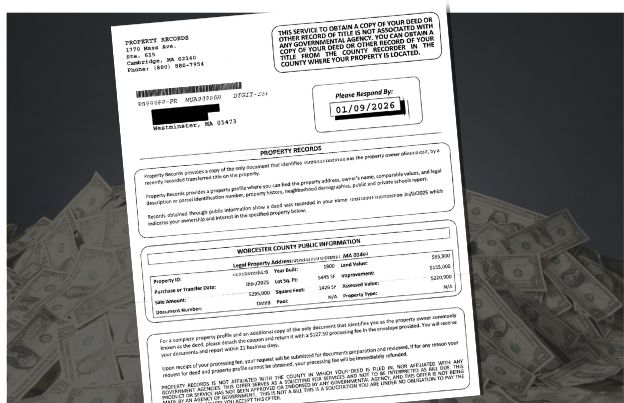
Common Post-Closing Mail Homeowners Can Safely Ignore
After you buy a home, it’s normal for mail to start showing up that references your property, your mortgage, or your ownership. Some of it is legitimate. Much of it is optional. And some of it can safely be ignored.
Knowing the difference can save time, money, and unnecessary worry.
Below are some of the most common types of post-closing mail homeowners ask about—and what they generally mean.
Recorded Deed or Property Record Notices
These letters typically offer to provide copies of documents related to your ownership for a fee.
In most cases, these documents are already recorded and available directly through the Registry of Deeds. Purchasing them from a third party is optional and rarely necessary.
Home Warranty Offers
Many homeowners receive multiple home warranty solicitations shortly after closing.
These are not required, even if the letter references your recent purchase or implies urgency. Some warranties may be useful depending on your situation, but they are optional service contracts—not part of the closing process.
Mortgage Life Insurance Solicitations
These notices often suggest coverage tied specifically to your mortgage balance.
Mortgage life insurance is different from traditional life insurance and is not required by lenders. Whether it makes sense depends on your broader financial and insurance planning—not on the timing of the letter.
“Final Notice” or “Immediate Response Required” Mail
Mail labeled as a “final notice” frequently creates concern, especially when it arrives soon after closing.
In many cases, this language is a marketing tactic rather than a reflection of any actual deadline. The presence of urgency alone does not mean action is required.
Property Profiles, Reports, or Monitoring Services
Some mail offers property assessments, ownership monitoring, or record tracking services.
These products often rely on publicly available information and may duplicate records you already have or can access directly. Whether they provide value depends on the specific service—not on the fact that you recently closed.
Why There’s So Much Mail After Closing
The volume of post-closing mail surprises many homeowners, but it isn’t random.
Once a transaction is recorded, ownership becomes part of the public record. That visibility—combined with timing—is what drives much of the outreach homeowners receive.
A Simple Rule of Thumb
A Simple Rule of Thumb
If a piece of mail:
- Requests payment
- References your deed, mortgage, or ownership
- Uses urgent language
- Arrives shortly after closing
…it’s worth pausing before responding.
Most post-closing notices are informational or optional. Very few require immediate action.
When in Doubt, Ask
If you’re unsure about something you receive after closing, reach out to one of your real estate professionals—your agent, loan officer, or closing attorney.
Our office is always available to review documents and help you determine whether something requires action or can be safely ignored.
Providing title, escrow, closing and settlement services to clients throughout Massachusetts and New Hampshire


Recent News

What Real Estate Agents Need to Know About FinCEN’s New Residential Real Estate Reporting Rule (Effective March 1, 2026)
⚠️ Update (March 20, 2026): A federal court has vacated FinCEN’s Residential Real Estate Reporting Rule, and it is not currently enforceable nationwide. However, an appeal is expected. Industry professionals are advised to continue preparing transactions as if the...
New Homeowners Beware: “Recorded Deed” Letters That Aren’t What They Seem
Buying your first home is exciting—and it often comes with a mountain of paperwork. Unfortunately, it can also make you a target for misleading solicitations that appear official and urgent, but offer nothing you actually need.One of the most common examples we see...

The Mindset Shift: Gearing Up for a Killer 2026 Market
The preparation you do now decides the results you get later. 2026 won’t reward the loudest agents.It will reward the most prepared ones.If 2026 Is Your Year, Start Acting Like It Now A January reset for agents who want to last Every agent wants to be ready when the...