FAQ
Real estate transactions often come with questions—before, during, and after closing. This page serves as a practical resource where we address common concerns with clear, straightforward answers.
As new questions arise, this section will continue to grow. If you don’t see what you’re looking for, feel free to reach out for guidance.
Watch this video to help protect your money from wire fraud schemes!
Post-Closing Mail & Recorded Deed FAQs
Buying a home often comes with unexpected mail after closing. These frequently asked questions address what homeowners commonly ask—and where to find more detail if needed.
Why am I getting so much mail after I buy a home?
When your home purchase closes, your deed is recorded at the Registry of Deeds. That recording is required by law and becomes part of the public record.
Once ownership is recorded, certain details—such as the property address and the fact that a transaction occurred—are publicly accessible. This visibility is what drives much of the post-closing mail homeowners receive.
Does post-closing mail mean something went wrong with my closing?
No. Receiving mail after closing does not indicate a problem, missing step, or incomplete transaction.
In Massachusetts, once your deed is recorded, your ownership is legally secure. Post-closing mail reflects public record visibility—not a requirement to take action.
What are “recorded deed” letters, and are they required?
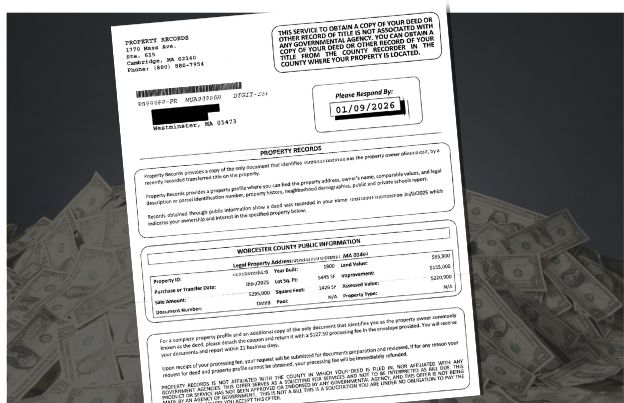
Recorded deed letters typically offer to provide copies of your deed or property records for a fee.
These services are optional. Your deed is already recorded at closing, and copies are usually available directly from the Registry of Deeds for a minimal cost. You are not required to purchase a deed copy from a third party.
➡ For examples of these letters and what to do if you receive one, read: New Homeowners Beware: “Recorded Deed” Letters That Aren’t What They Seem
Are these letters sent by the county or the state?
Typically, no.
Most recorded deed or property record mailings come from private companies, not government offices. While disclaimers may be included, they are often easy to overlook.
Understanding who the sender is—and who they are not—is key.
Why do these letters arrive so quickly after closing?
Many companies monitor public recording data using automated systems. Once a new deed is recorded, it can trigger mailings almost immediately.
The timing is driven by automation and public data access—not by any action you took.
What other types of post-closing mail are common?
Homeowners often receive:
- Home warranty offers
- Mortgage life insurance solicitations
- Property profiles or assessment reports
- Ownership or record monitoring services
- Mail labeled “final notice” or “urgent response required”
Most of these are optional services or marketing materials—not required steps.
➡ For a breakdown of common post-closing mail and what it usually means, see: Common Post-Closing Mail Homeowners Can Safely Ignore
How can I tell if something actually requires action?
A good rule of thumb is to pause before responding to mail that:
- Requests payment
- Uses urgent or threatening language
- References your deed, mortgage, or ownership
- Arrives shortly after closing
Very few post-closing notices require immediate action. When in doubt, ask before responding.
Where can I get a copy of my deed if I need one?
In Massachusetts, you can obtain a copy of your recorded deed directly from your county Registry of Deeds—often online and for a nominal fee.
This is the most reliable and cost-effective way to access your records.
Who should I contact if I’m unsure about a letter I received?
If you have questions or concerns about post-closing mail, reach out to one of your real estate professionals—your agent, loan officer, or closing attorney.
Our office is always available to review documents and help determine whether something requires action or can be safely ignored.
Where can I learn more about this topic?
For deeper explanations and examples, we recommend:
- New Homeowners Beware: “Recorded Deed” Letters That Aren’t What They Seem – visual examples and action guidance
- Why New Homeowners Get Targeted After Closing – system-level explanation of why this happens
Want to See What These Mailers Look Like—and What to Do If You Receive One?
We’ve broken that down separately.
Download the Recorded Deed Notice, it covers:
- Common characteristics of these mailings
- Why they can feel official or urgent
- What action, if any, is actually required
If something ever raises questions, a quick check with your closing attorney can provide clarity before you respond.