156 Hamilton St., Leominster, MA
         
Why New Homeowners Get Targeted After Closing

Why New Homeowners Get Targeted After Closing

Why New Homeowners Get Targeted After Closing

For many buyers, one of the most surprising parts of homeownership happens after the closing is complete: the sudden increase in mail related to their property.

This isn’t accidental—and it isn’t unique to any one company or offer. It’s the predictable result of how real estate ownership is recorded and shared.

A Recorded Deed Is a Public Signal

When a home purchase closes, the deed is recorded at the Registry of Deeds. This step is required to legally establish ownership, and it creates a permanent public record.

That recording does more than confirm who owns the property. It also signals, very clearly, that:

  • A transaction just occurred
  • A new owner is in place
  • The information is finalized and searchable

From a systems perspective, a newly recorded deed is an event marker.

Public Records Are Designed to Be Accessible

Registries of deeds are built to support transparency. Lenders, municipalities, courts, and title professionals rely on immediate access to ownership data to function properly.

Because of that:

  • New recordings can be observed as soon as they are filed
  • Ownership changes are easy to track at scale
  • No notification is required to access the information

This openness is a feature of the system—not a flaw.

Why New Owners Appear on Radars Immediately

Many private companies routinely monitor public recording data. When a new residential deed is filed, it can be flagged instantly and added to a database of recent transactions.

The result is that new homeowners often appear on mailing lists shortly after closing—not because they opted in, but because the ownership change became public.

The speed at which this happens is driven by automation, not human review.

Timing Matters More Than Identity

New homeowners aren’t targeted because of who they are. They’re targeted because of when they appear in the system.

The post-closing period is a narrow window in which:

  • Ownership data is fresh
  • Buyers expect follow-up documentation
  • Familiarity with post-closing norms is still developing

From a behavioral standpoint, it’s a moment of high attention and low context. That timing—not vulnerability or mistake—is what makes new ownership records valuable to third parties.

This is a Structural Reality, Not a Closing Issue

The appearance of post-closing mail does not reflect a problem with the transaction itself. It does not indicate that something was missed or improperly handled.

It simply means the ownership record has been finalized and made visible.

Understanding that distinction helps separate administrative reality from perceived obligation.

Why Context Is Often Missing

Public records show that ownership changed—not what the homeowner already has, received, or understands.

Without that context, third-party outreach can feel confusing or authoritative, even when no action is required. The confusion stems from incomplete information, not from the recording process itself.

A Useful Perspective

Once a deed is recorded, ownership becomes part of a broader information system. What follows is less about the homeowner—and more about how public data moves once it exists.

Understanding that framework makes it easier to evaluate post-closing communication calmly and confidently.

Want to See What These Mailers Look Like—and What to Do If You Receive One?

We’ve broken that down separately.

Download the Recorded Deed Notice, it covers:

  • Common characteristics of these mailings
  • Why they can feel official or urgent
  • What action, if any, is actually required

If something ever raises questions, a quick check with your closing attorney can provide clarity before you respond.

Common Post-Closing Mail Homeowners Can Safely Ignore

After you buy a home, it’s normal for mail to start showing up that references your property, your mortgage, or your ownership. Some of it is legitimate. Much of it is optional. And some of it can safely be ignored.

Knowing the difference can save time, money, and unnecessary worry.

Below are some of the most common types of post-closing mail homeowners ask about—and what they generally mean.

Recorded Deed or Property Record Notices

These letters typically offer to provide copies of documents related to your ownership for a fee.

In most cases, these documents are already recorded and available directly through the Registry of Deeds. Purchasing them from a third party is optional and rarely necessary.

Home Warranty Offers

Many homeowners receive multiple home warranty solicitations shortly after closing.

These are not required, even if the letter references your recent purchase or implies urgency. Some warranties may be useful depending on your situation, but they are optional service contracts—not part of the closing process.

Mortgage Life Insurance Solicitations

These notices often suggest coverage tied specifically to your mortgage balance.

Mortgage life insurance is different from traditional life insurance and is not required by lenders. Whether it makes sense depends on your broader financial and insurance planning—not on the timing of the letter.

“Final Notice” or “Immediate Response Required” Mail

Mail labeled as a “final notice” frequently creates concern, especially when it arrives soon after closing.

In many cases, this language is a marketing tactic rather than a reflection of any actual deadline. The presence of urgency alone does not mean action is required.

Property Profiles, Reports, or Monitoring Services

Some mail offers property assessments, ownership monitoring, or record tracking services.

These products often rely on publicly available information and may duplicate records you already have or can access directly. Whether they provide value depends on the specific service—not on the fact that you recently closed.

Why There’s So Much Mail After Closing

The volume of post-closing mail surprises many homeowners, but it isn’t random.

Once a transaction is recorded, ownership becomes part of the public record. That visibility—combined with timing—is what drives much of the outreach homeowners receive.

A Simple Rule of Thumb

A Simple Rule of Thumb

If a piece of mail:

  • Requests payment
  • References your deed, mortgage, or ownership
  • Uses urgent language
  • Arrives shortly after closing

…it’s worth pausing before responding.

Most post-closing notices are informational or optional. Very few require immediate action.

When in Doubt, Ask

If you’re unsure about something you receive after closing, reach out to one of your real estate professionals—your agent, loan officer, or closing attorney.

Our office is always available to review documents and help you determine whether something requires action or can be safely ignored.

Providing title, escrow, closing and settlement services to clients throughout Massachusetts and New Hampshire

Recent News

Not Another Boring Market Update

Not Another Boring Market Update

If you’ve been watching the Massachusetts housing market lately, you’re probably getting that weird feeling that something’s just… off. Homes are still selling. Prices haven’t really dropped. But everything feels slower. Quieter. More hesitant. Like everyone’s waiting...
Why New Homeowners Get Targeted After Closing

Why New Homeowners Get Targeted After Closing

For many buyers, one of the most surprising parts of homeownership happens after the closing is complete: the sudden increase in mail related to their property. This isn’t accidental—and it isn’t unique to any one company or offer. It’s the predictable result of how...

New Homeowners Beware: “Recorded Deed” Letters That Aren’t What They Seem

New Homeowners Beware: “Recorded Deed” Letters That Aren’t What They Seem

New Homeowners Beware

“Recorded Deed” Letters That Aren’t What They Seem

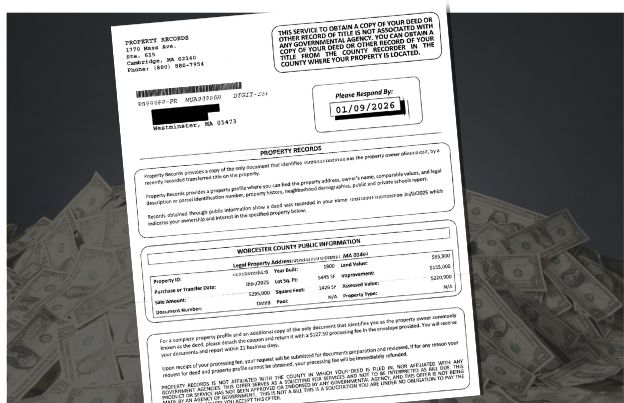
Buying your first home is exciting—and it often comes with a mountain of paperwork. Unfortunately, it can also make you a target for misleading solicitations that appear official and urgent, but offer nothing you actually need.

One of the most common examples we see involves letters offering to provide a copy of your recorded deed or a “property assessment report” for a substantial fee—often $125 or more. These letters are not required, not helpful, and not sent by the county or the Commonwealth of Massachusetts.

If you recently purchased a home and received something like this in the mail, here’s what you should know.

What These Letters Typically Say

These mailings are carefully designed to look important. Common features include:

  • Your name and property address
  • A reference to a “Recorded Deed,” “Grant Deed,” or “Property Records”
  • A deadline urging you to “respond by” a certain date
  • Language about verifying ownership or protecting your property
  • A service or processing fee (often $125–$130)
  • Fine‑print disclaimers stating the sender is not affiliated with the government

Some letters emphasize that they will obtain “the only document that identifies you as the property owner,” or that you must act quickly to secure a copy of your deed.

While these statements may sound serious, they are misleading at best.

The Truth: You Do Not Need This Service in Massachusetts

In Massachusetts:

  • Your deed is already recorded at the Registry of Deeds when you buy your home
  • Your ownership is legally secure without taking any further action
  • You are not required to purchase a copy of your recorded deed from a private company

In fact, most buyers already receive a copy of their deed as part of the closing process. Even if you don’t have one on hand, you can easily obtain it directly from the county Registry of Deeds, usually online and for a nominal fee—often just a few dollars.

There is no legal requirement to purchase a deed copy, property profile, or assessment report from a mail‑order company after closing.

Why These Solicitations Are Misleading

Although these companies often include disclaimers stating “this is not a bill” or “not affiliated with any government agency,” those statements are typically buried in fine print.

The overall presentation is intentionally designed to:

  • Mimic official government notices
  • Create a false sense of urgency
  • Suggest that your ownership is incomplete or at risk
  • Target new homeowners, when deed recordings are public and easy to track

Importantly, these companies are simply repackaging public information that is already available to you—often at many times the actual cost.

Are These Letters Illegal?

Not necessarily—but that does not mean they are appropriate or ethical.

Many of these mailers rely on technical compliance disclaimers to avoid violating consumer protection laws. However, the Massachusetts Attorney General and consumer advocacy organizations have long warned buyers to be cautious of solicitations that:

  • Use government‑style formatting
  • Imply legal necessity without saying so directly
  • Charge excessive fees for freely available public records

What You Should Do If You Receive One

If you receive a letter offering to obtain your deed or property records for a fee:

  1. Do not send payment
  2. Do not assume it is required or time‑sensitive
  3. Check the fine print—you will usually find admissions that it is a solicitation
  4. Contact your closing attorney if you are unsure
  5. If you need a deed copy, visit your local Registry of Deeds website directly

How to Get a Copy of Your Deed the Right Way

In Massachusetts, you can obtain your recorded deed by:

  • Visiting your county Registry of Deeds website
  • Searching by name, address, or document number
  • Downloading a copy—often the same day—for a minimal recording fee

This direct route is faster, cheaper, and avoids third‑party markups entirely.

Receiving mail like this can be confusing—especially shortly after closing, when everything still feels unfamiliar. Remember:

  • Your deed is already recorded
  • Your ownership is already protected
  • You are not missing anything—and you do not need to respond

If you ever have questions about documents you receive after your purchase, contact our office. A quick review can save you time, money, and unnecessary stress.

Want to See What These Mailers Look Like—and What to Do If You Receive One?

We’ve broken that down separately.

Download the Recorded Deed Notice, it covers:

  • Common characteristics of these mailings
  • Why they can feel official or urgent
  • What action, if any, is actually required

If something ever raises questions, a quick check with your closing attorney can provide clarity before you respond.

Providing title, escrow, closing and settlement services to clients throughout Massachusetts and New Hampshire

Recent News

Not Another Boring Market Update

Not Another Boring Market Update

If you’ve been watching the Massachusetts housing market lately, you’re probably getting that weird feeling that something’s just… off. Homes are still selling. Prices haven’t really dropped. But everything feels slower. Quieter. More hesitant. Like everyone’s waiting...

Why New Homeowners Get Targeted After Closing

Why New Homeowners Get Targeted After Closing

For many buyers, one of the most surprising parts of homeownership happens after the closing is complete: the sudden increase in mail related to their property. This isn’t accidental—and it isn’t unique to any one company or offer. It’s the predictable result of how...

The Mindset Shift: Gearing Up for a Killer 2026 Market

The Mindset Shift: Gearing Up for a Killer 2026 Market

The Mindset Shift

Gearing Up for a Killer 2026 Market

The preparation you do now decides the results you get later.

2026 won’t reward the loudest agents.
It will reward the most prepared ones.

If 2026 Is Your Year, Start Acting Like It Now

A January reset for agents who want to last

Every agent wants to be ready when the market turns.
Very few actually prepare before it does.

Strong markets don’t lift everyone equally. They separate agents who are positioned from those who are scrambling. And the difference is rarely talent or luck—it’s preparation.

January isn’t about hype.
It’s about deciding who you’re going to be when opportunity shows up.

The Market Doesn’t Make Agents — Agents Make Themselves

Here’s the reality most people don’t like to admit:

Every “great” market still has winners and casualties.

Some agents thrive. Others disappear. And it’s not because one group predicted the market better. It’s because one group entered it prepared.

Preparation decides:

  • Who sounds confident in client conversations
  • Who freezes when asked hard questions
  • Who builds momentum when demand increases

Markets don’t create professionals.
They expose them.

You’re Not Behind — You’re Early

If things feel quiet right now, that’s not a failure.
It’s a training window.

Quiet markets are where:

  • Skills get sharpened without pressure
  • Confidence is built before it’s tested
  • Habits form without chaos

Agents who panic during slower periods chase validation.
Agents who prepare during them build careers.

Confidence isn’t built during demand spikes.
It’s built before anyone is watching.

Think Like a Professional Before You Feel Like One

You don’t wake up one day feeling like a seasoned agent.
You become one by adopting professional behaviors early.

A 2026-ready agent:

  • Asks better questions instead of talking louder
  • Guides conversations instead of chasing approval
  • Chooses consistency over bursts of intensity
  • Understands that calm confidence beats hype every time

Identity comes before results.
Act like the professional you’re becoming—not the one you’re waiting to feel like.

What Prepared Agents Do Differently

This isn’t about tactics yet.
It’s about how prepared agents operate.

They:

  • Rehearse conversations instead of winging them
  • Walk into consults with structure, not nerves
  • Pause instead of panicking when objections surface
  • Build clarity before urgency ever enters the room

Prepared agents don’t sound rushed.
They sound grounded.

That’s what clients trust.

Your 2026 Readiness Reset

This is where intention turns into action.

We’ve created a simple January Reset Worksheet to help agents move from motivation to momentum.

It asks just four things:

  • One skill I will master this year
  • One conversation I will stop avoiding
  • One habit I will build weekly
  • One way I’ll measure progress

No overwhelm. No fluff.
Just clarity.

Escrow Agent

THIS ONE IS FOR YOU!

A one-page worksheet designed to be printed, saved, and revisited.

The market will change.

Your preparation doesn’t have to.

Confidence isn’t something you wait for.
It’s something you build—quietly, consistently, on purpose.

The agents who win in 2026 won’t be the loudest.
They’ll be the ones who started preparing when it was still quiet.

Providing title, escrow, closing and settlement services to clients throughout Massachusetts and New Hampshire

Recent News

Not Another Boring Market Update

Not Another Boring Market Update

If you’ve been watching the Massachusetts housing market lately, you’re probably getting that weird feeling that something’s just… off. Homes are still selling. Prices haven’t really dropped. But everything feels slower. Quieter. More hesitant. Like everyone’s waiting...

Why New Homeowners Get Targeted After Closing

Why New Homeowners Get Targeted After Closing

For many buyers, one of the most surprising parts of homeownership happens after the closing is complete: the sudden increase in mail related to their property. This isn’t accidental—and it isn’t unique to any one company or offer. It’s the predictable result of how...

The January Reality Check

The January Reality Check

The January Reality Check

Why January Is One of Your Most Important Months

January is when clients stop reacting emotionally and start confronting numbers. Insurance renewals, tax bills, and HOA increases hit inboxes all at once — and most buyers and sellers are quietly reassessing whether their plans still work.


This is your moment to lead.


Not by pushing timelines, but by helping clients recalculate reality before spring momentum takes over.

How to Position the Conversation

Use January to shift from “market updates” to decision clarity.

You’re not predicting the market.
You’re helping clients pressure-test their plan.

That distinction matters.

Talking Points You Can Use Immediately

Reframe January as a Planning Window

“January is when the real costs of homeownership show up. Before we talk timing, I want to make sure the numbers still work for you.”

This positions you as a professional, not a hype messenger.

Address Insurance Early
(Before it Blows Up a Deal)

“Insurance is impacting approvals and affordability more than people realize. Let’s look at it now so there are no surprises later.”

This builds trust and prevents last-minute fallout.

Normalize Re-Running the Numbers

“Most people base decisions on last year’s costs. January is the right time to update everything.”

You’re giving permission to slow down — which actually speeds up good decisions.

Reassess Spring Expectations

“Spring markets reward preparation. January is where that preparation happens.”

This keeps you aligned with long-term outcomes, not rushed listings.

What This Does for You as an Agent

  • Positions you as calm, credible, and strategic
  • Reduces failed transactions later
  • Improves listing quality and buyer readiness
  • Builds loyalty through honesty

You’re not selling urgency.
You’re selling clarity.

Providing title, escrow, closing and settlement services to clients throughout Massachusetts and New Hampshire

Recent News

Not Another Boring Market Update

Not Another Boring Market Update

If you’ve been watching the Massachusetts housing market lately, you’re probably getting that weird feeling that something’s just… off. Homes are still selling. Prices haven’t really dropped. But everything feels slower. Quieter. More hesitant. Like everyone’s waiting...

Why New Homeowners Get Targeted After Closing

Why New Homeowners Get Targeted After Closing

For many buyers, one of the most surprising parts of homeownership happens after the closing is complete: the sudden increase in mail related to their property. This isn’t accidental—and it isn’t unique to any one company or offer. It’s the predictable result of how...

The One Holiday Script That Gets More Replies Than Anything Else

The One Holiday Script That Gets More Replies Than Anything Else

The One Holiday Script That Gets More Replies Than Anything Else

Sometimes you just need one thing — one message — that cuts through the noise and gets people talking to you again.

This is the holiday script that agents and LOs keep saying works better than anything else in their pipeline.

And yes, you can copy/paste it.

The Script:

“Happy holidays! I’m wrapping up my year, and I always check in with the people I’ve genuinely enjoyed working with. Anything major happening in 2026 — real estate, financial goals, moving plans — that you want me to keep an eye out for?”

Here’s why this works:

  • It’s personal.
  • It’s conversational.
  • It’s not sales-driven.
  • It puts the client in control.
  • It triggers real conversations about next-year plans.

And the replies you get?
They’re usually longer, honest, and actionable.

Bonus Tip: Send It as a Voice Text

Your voice feels more real than typed words.

Clients respond at a higher rate because it sounds like a human — not a blast message.

Then Follow Up With a Micro-Offer

Once they reply, send:

“If you ever want a quick market check for your town or a numbers breakdown, just tap me. I’m happy to help.”

It positions you as a resource without pressure.

Providing title, escrow, closing and settlement services to clients throughout Massachusetts and New Hampshire

Recent News

Not Another Boring Market Update

Not Another Boring Market Update

If you’ve been watching the Massachusetts housing market lately, you’re probably getting that weird feeling that something’s just… off. Homes are still selling. Prices haven’t really dropped. But everything feels slower. Quieter. More hesitant. Like everyone’s waiting...

Why New Homeowners Get Targeted After Closing

Why New Homeowners Get Targeted After Closing

For many buyers, one of the most surprising parts of homeownership happens after the closing is complete: the sudden increase in mail related to their property. This isn’t accidental—and it isn’t unique to any one company or offer. It’s the predictable result of how...