Sep 14, 2011 | Personal Finance
It’s no secret. Rates are low right now. And, it’s not just mortgage rates, either — all types of rates are scraping rock-bottom. Borrowing rates, lending rates and savings rates are at or near their all-time lowest levels.
As a homeowner in Worcester , one way to take capitalize on today’s low rates is to apply to refinance your home. But there are other ways to take advantage, too.
In this 5-minute piece from NBC’s The Today Show, you’ll learn of a half-dozen ways to exploit the current rate environment, including:
- Refinance a car loan from a high rate to a low rate, for cheap, in an hour
- Balance transfers between credit cards with teaser rates lasting up to 20 months
- Move some savings to an “online” bank where savings rates are higher
The interview’s theme is to examine both where you’re spending and saving your money, and make sure you’re doing what’s best for your budget.
Federal Reserve Chairman Ben Bernanke has pledged to hold the Fed Funds Rate near 0.000% until at least 2013. So long as the Fed Funds Rate is low, there will be places you can save.
Sep 13, 2011 | Buying Real Estate, Mortgage Lenders, Mortgage Rates, News

For the first time in a year, homeowners with adjusting mortgages are facing rising mortgage rates. The interest rate by which many adjustable-rate mortgages adjust has climbed to its highest level since September 2010, and looks poised to reach higher.
This is because of the formula by which adjustable-rate mortgage adjust.
Each year, when due for a reset, an adjustable-rate mortgage’s rate changes to the sum of fixed number known as a “margin”, and a variable figure known as an “index”. For conforming mortgages, the margin is typically set to 2.250 percent; the index is often equal to the 12-month LIBOR.
LIBOR stands for the London Interbank Offered Rate. It’s a rate at which banks lend to each other overnight.
Expressed as a math formula, the adjusting ARM formula reads : (more…)
Sep 12, 2011 | Around The Home
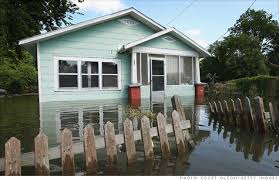 Everyone lives in a flood zone.
Flooding is the top-ranked natural disaster in the United States, with a dozen potential causes ranging from heavy rains, tropical storms and hurricanes to new housing developments and rain after fire. Floods can occur in all 50 states and, when they do, they leave massive damage in their wake.
Flood damages exceed $2.7 billion annually.
As a homeowner, you carry homeowners insurance to protect against theft and loss. Typical homeowners insurance, however, excludes damages from flooding. Homeowners in Worcester County, therefore, should consider having a separate flood insurance policy. And once that policy is in place, there are other steps you should follow, too. (more…)
Sep 9, 2011 | Buying Real Estate, Housing Analysis, Interesting Stuff, Selling Real Estate, The Economy
 Home affordability slipped slightly last quarter, dragged down by rising mortgage rates and recovering home prices in Massachusetts and nationwide.
The National Association of Home Builders reports a Q2 2011 Home Opportunity Index reading of 72.6. This means that nearly 3 of 4 homes sold last quarter were affordable to households earning the national median income of $64,200.
Q2 2011 marks the 10th straight quarter — dating back to 2009 — in which the index surpassed 70.
Prior to 2009, the index had never crossed 70 even one time.
However, we must remember that the Home Affordability Index is a national survey. From region-to-region, and town-to-town, home affordability varied.
In the Midwest, for example, affordability was highest. 14 of the 15 most affordable markets nationwide were spread throughout Ohio, Michigan, Illinois and Indiana. Only Syracuse (#9) cracked the list from other regions.
The top 5 most affordable cities in Q2 2011 were: (more…)
Sep 8, 2011 | Buying Real Estate, Mortgage Guidelines, Mortgage Lenders, Mortgage Rates
 Mortgage guidelines appear to be tightening with the nation’s largest banks.
In its quarterly survey to senior loan officers nationwide, the Federal Reserve uncovered that a small, but growing, portion of its member banks is making mortgage approvals more scarce for “prime” borrowers.
A prime borrower is described as one with a well-documented payment history, high credit scores, and a low monthly debt-to-income ratio.
Of the 53 responding “big banks”, 3 reported that mortgage guidelines “tightened somewhat” last quarter. This is a tick higher as compared to prior quarters in which only 2 banks did.
46 banks reported guidelines unchanged from Q1 2011.
When mortgage guidelines tighten, it adds new hurdles for would-be home buyers in Fitchburg. Tighter lending standards means fewer approvals, and that can retard home sales across a region.
Just don’t confuse “tighter standards” with “oppressive standards”. (more…)
