Dec 3, 2010 | Uncategorized
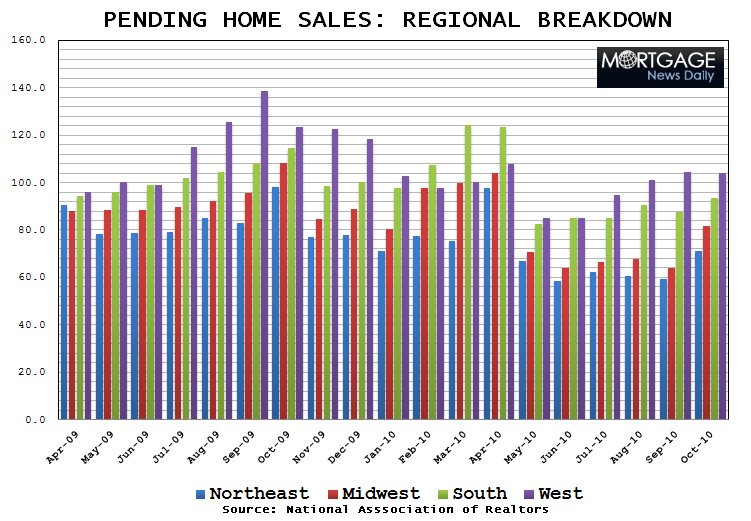
The National Association of Realtors® (NAR) Pending Home Sales Index measures the number of home purchase contracts that were signed in the monthly reporting period. Once “pending” sales contracts are closed, they are considered an Existing Home Sale. Because the Pending Home Sales index tells us how many contracts were signed, it is considered a forward indicator of Existing Home Sales. A signed contract is not counted as an Existing Home Sale until the transaction actually closes.
Nov 11, 2010 | Buying Real Estate, Interesting Stuff, Mortgage Lenders, News, Realtors
HUD’s videos are easily accessible from HUD’s website as well as from HUD’s YouTube channel.Keeping up with the changing times and the push of social media the Department of Housing and Urban Development (HUD) has set up a YouTube Channel. HUD has unveiled three how-to videos to assist potential homebuyers find an affordable home, shop for the right mortgage and what to expect at closing. (more…)
Jun 29, 2010 | Buying Real Estate, Legislation, Realtors
Today the House of Representatives voted 409 to 5 to give home buyers three more months to close on their purchases and still qualify for the $8,000 or $6,500 federal income tax credit.
The House bill extends the closing deadline to September 30, 2010.
Now the Senate must approve the new, stand-alone House bill. But the Senate has already shown support and approval of the measure by having passed their own version of the bill last week.
The House bill doesn’t help anyone currently shopping for a home. Buyers must have signed a purchase contact by April 30 to qualify for the tax break. The issues currently is that many who now qualify for the credit may not be able to close their transaction in time. That is by July 1, 2010.
Read more on Inman News.
Jun 24, 2010 | Interesting Stuff, Legislation
The debate over the unauthorized practice of law in Massachusetts took a new twist this week.
A 2009 ruling in favor of National Real Estate Information Services Inc. (NREIS) in an unauthorized practice of law case brought by the Real Estate Bar Association for Massachusetts Inc. (REBA) has been vacated by the First Circuit Court of Appeals.
According to the June 21 order to vacate, the appeals court said it would let the Massachusetts Supreme Judicial Court decide what constitutes the practice of law in the state encompassing all the interconnected activities of a real estate conveyance and the issuance of title insurance, and whether or not non-attorneys can conduct “witness” or “notary” closings. The appeals court said the district court construed the sparse state case law and declared the practices at issue did not constitute the unauthorized practice of law.
This decision will impact who can capture title insurance premiums in Massachusetts. Last year, $198 million in title premiums were generated in the state.
In 2009, United States District Judge Joseph L. Tauro entered an order of summary judgment in favor of NREIS, enjoining REBA from enforcing its interpretation of the practice of law.
In the court’s decision, Tauro agreed with NREIS’ position that the definition of the practice of law as set forth by REBA was a violation of the Dormant Commerce Clause of the United States Constitution. The order to vacate also reverses the district court’s decision on NREIS’s dormant Commerce Clause counterclaim. NREIS claimed that requiring attorneys to conduct closings was an unconstitutional restraint on trade that would result in higher closing costs.
REBA had filed the original lawsuit in 2006 in an attempt to restrict the provision of title, settlement and closing services by Massachusetts attorneys only. The decision marked the first time a Federal District Court has ruled on the issue of unauthorized practice of law as it relates to settlement services.
(more…)
Apr 21, 2010 | Buying Real Estate, Legislation, Realtors, Selling Real Estate, Short Sales
The Home Affordable Foreclosure Alternatives (HAFA) program is a part of the Home Affordable Modification Program (HAMP), and offers a streamlined process for short sales and deeds-in-lieu of foreclosure. HAFA will allow homeowners to discharge their first mortgage debt without the credit-destroying step of foreclosure. The program also offers a $1,000 incentive to banks to permit short sales and a $1,500 bonus to homeowners for the purpose of relocation.
The HAFA program has eligibility guidelines:
• The property must be the owner’s principal residence
• The first mortgage must have originated before 2009
• The unpaid principal must be less than $729,750 for a single-family dwelling
• The borrower’s monthly payment must exceed 31% of their gross income
• The mortgage must either be delinquent or a default be reasonably foreseeable.
If borrowers meet the program requirements they will receive pre-approved short sale terms from their lender, which will include a minimum acceptable proceeds figure for the sale. The homeowner will be required to list the property for sale with a Realtor® and close within 120 day, extensions may be permitted up to a total of 12 months.
Based on the short sale agreement with the lender, HAFA requires property owners to be fully released from any future liability on their first mortgage debt, and in some cases, subordinate debts, so that when the home is sold, the borrower is free and clear of their mortgage.
The program ends on December 31, 2012. HAFA does not apply to FHA or VA loans. There is an extensive amount of paperwork to be completed to participate in the program, Homeowners wishing to take advantage of the relief offered are encouraged to work with a experienced Realtor®.
